
There’s a particular kind of frustration that only a practitioner would understand. You trained for over a decade. You’re good genuinely good at what you do. Your patients love you, your outcomes are strong, your waiting room is full of thank-you cards. And yet, your appointment book has gaps you can’t explain, while a clinic two streets away with a fraction of your experience seems to be fully booked every week.
The uncomfortable truth is this: you’re not losing patients to better doctors. You’re losing them to better visibility.
What It Feels Like From Behind the Desk
Talk to any practice manager or consultant honestly, and you’ll hear some version of the same story: “I don’t understand why my clinic isn’t showing up on Google Maps.” Or, “Why did my rankings suddenly drop after we redid the website?” Or the quiet panic of realizing a competitor is ranking for your own clinic’s name.
This isn’t a failure of clinical skill. It’s that nobody trained you to manage a Google Business Profile, monitor broken links, or understand why a beautifully designed new website can tank your search rankings overnight if it wasn’t migrated properly. That’s not a gap in your competence, it’s a gap in your job description. You didn’t sign up to be your own SEO manager, and you shouldn’t have to be.
What It Feels Like From the Other Side of the Search Bar
Now flip it. You’re a patient maybe self-pay, maybe deciding whether to use your BUPA or AXA cover, maybe just tired of NHS waiting lists and looking for a private consultant near Harley Street or your local high street. You search, you compare, you read reviews. You’re not just choosing a specialism; you’re choosing a level of trust with something deeply personal -your body, your child’s health, your peace of mind.
If a practice doesn’t show up, or shows up with outdated hours, no reviews, or a website that looks abandoned, patients don’t assume “they’re just bad at marketing.” They assume “if they can’t manage this, what else are they not managing?” Fair or not, that’s the psychology. In private healthcare especially, where patients are actively comparing providers on directories like Doctify and Top Doctors, invisibility is read as inferiority even when it isn’t true.
Where the Two Perspectives Meet
This is exactly why generic marketing advice doesn’t work for medicine. A private GP practice, a physiotherapy clinic, a plastic surgeon’s consultancy, and a dental practice are not the same business with different logos -they have entirely different patient journeys, different regulatory considerations (CQC and GMC compliance genuinely matters to how content should be written), and different definitions of a “good” lead. A patient searching “chiropractor near me” wants urgency and convenience. A patient searching “seo for private consultants” -well, that’s actually you, the practitioner, searching for help. Both searches deserve to land somewhere that understands the difference.
Good medical SEO isn’t about gaming an algorithm. It’s about:
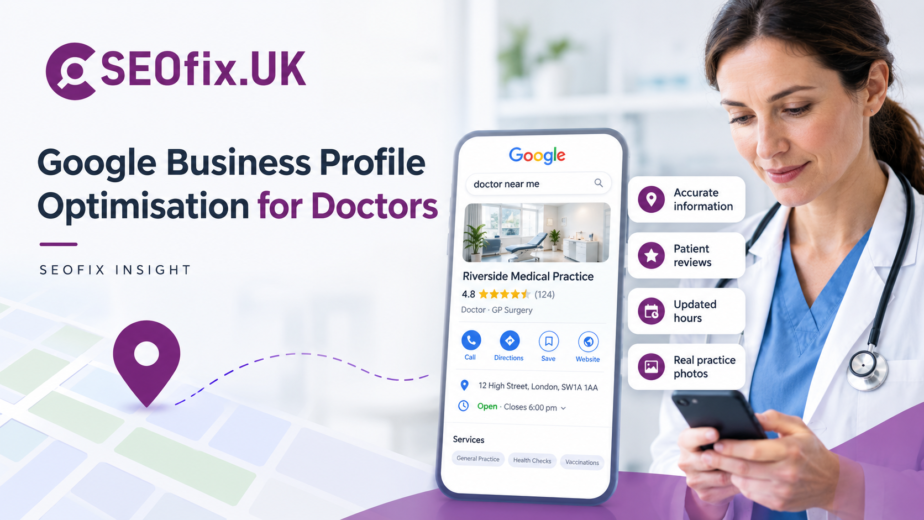
- Making sure your Google Business Profile reflects reality – right hours, right location, right specialisms, so you’re not invisible the moment someone searches locally.
- Building content that answers the actual questions worried patients type into Google, in language a real doctor would use, not a copywriter guessing at symptoms.
- Fixing the technical debt broken links, slow load times, poor mobile experience that quietly costs you rankings without ever sending an error message.
- Managing your reputation actively, because one unanswered negative review does more damage to a private clinic than almost any other industry, precisely because trust is the whole product.
The Real Ask
If you’re a practitioner reading this and nodding, here’s the honest pitch: you don’t need another agency that treats your clinic like a shoe shop. You need one that understands both sides of the desk -the clinical reality you live in, and the anxious, half-typed search query a patient sends into Google at 11pm. When those two things are finally speaking the same language, that’s when the empty slots in your diary start filling with the patients who were looking for you all along.
That’s the job. Everything else – the technical audits, the schema markup, the content calendars is just how we get there.